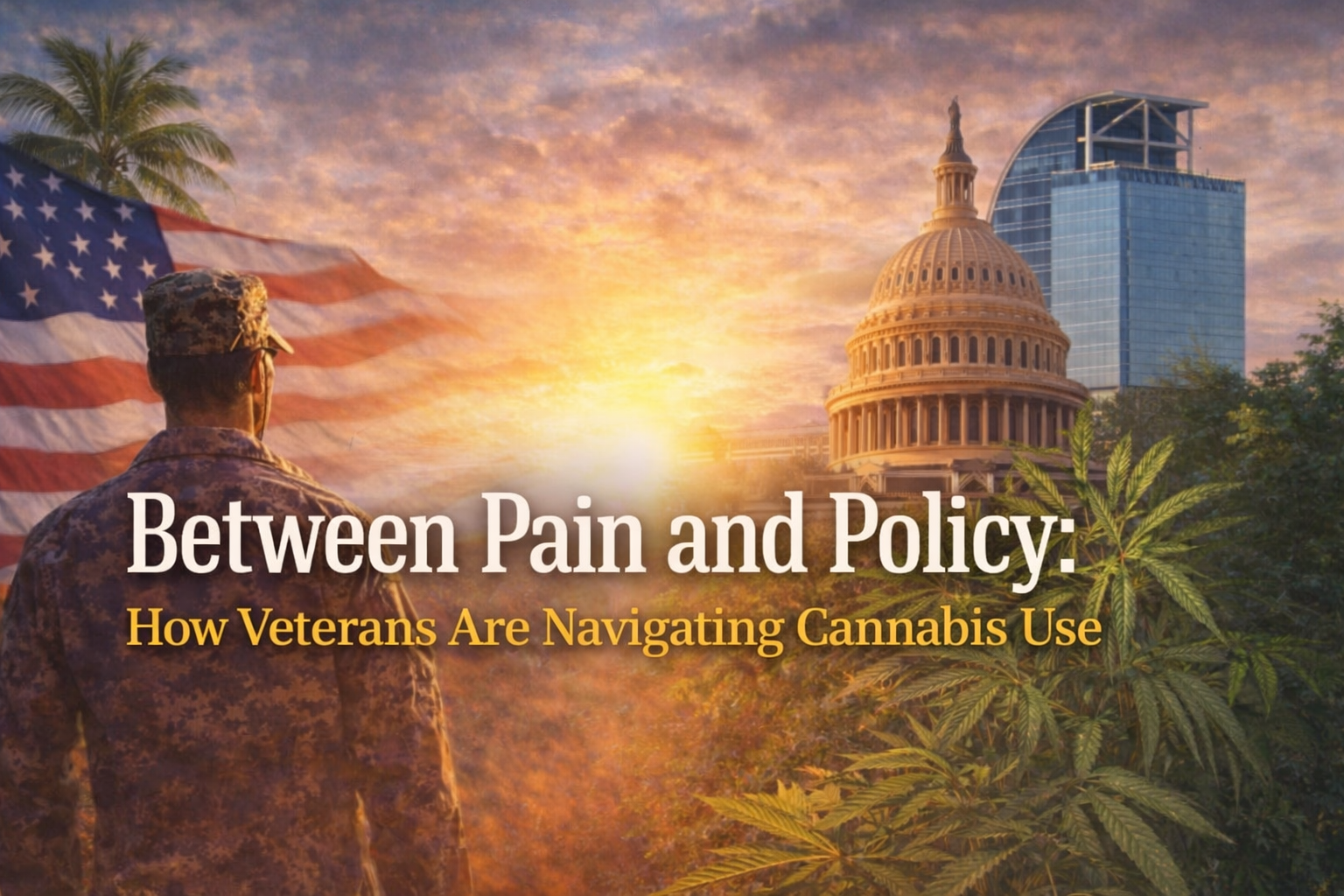
By Greg Bicknell | Smoke-N-Focus Media
For many U.S. veterans, leaving military service does not mean leaving pain behind. Instead, the transition to civilian life often includes long-term challenges such as chronic pain, post-traumatic stress disorder (PTSD), traumatic brain injury (TBI), anxiety, and severe sleep disruption. These conditions are commonly treated with medications that focus on symptom management rather than overall functioning or quality of life.
As frustration grows with the side effects of traditional medications — including opioids, antidepressants, anti-anxiety drugs, and sleep aids — an increasing number of veterans are exploring medical cannabis as either an alternative or a supplement to standardized treatment. While cannabis laws have expanded at the state level, its use remains legally and medically complicated at the federal level, particularly for veterans who rely on the Department of Veterans Affairs (VA) for their primary care.
As federal agencies work toward cannabis rescheduling and states expand medical access, veterans remain caught between the evolving policy changes and the day-to-day realities of managing pain, sleep disruption, and post-traumatic stress.
In Florida, where medical cannabis is legal but still tightly regulated, organizations such as Veterans Cannabis Care in Casselberry have stepped up to help veterans walk through the legal process, understand potential risks, and make informed decisions about their personal use.
Why This Matters
PTSD affects a significant portion of the veteran population but varies by service era. According to the U.S. Department of Veterans Affairs, an estimated 11–20% of post-9/11 veterans experience PTSD in any given year (VA, National Center for PTSD, 2023).
Mental health challenges among veterans are closely linked to suicide risk. The VA’s 2022 National Veteran Suicide Prevention Annual Report documented 6,407 veteran suicides, averaging more than 17 deaths per day. Suicide remains one of the leading causes of death among veterans, particularly those under the age of 65.
Sleep disorders and chronic pain frequently co-occur with PTSD, creating a cycle of fatigue, lack of emotion regulation, strained relationships, and reduced daily functioning. Research shows that untreated sleep disruption worsens PTSD symptoms and chronic pain over time.
According to the 2022 Substance Abuse and Mental Health Services Administration National Survey, approximately 9–12% of U.S. veterans report recent cannabis use, with significantly higher rates among those diagnosed with PTSD.
A System Built on Traditional Medication
For decades, the dominant medical response to veteran pain and trauma has relied heavily on prescription medications, particularly opioids and psychotropic drugs. While these treatments can be effective for some patients, many veterans report side effects such as decreased cognitive abilities, emotional numbness, dependency, and reduced engagement with daily life activities.
Veterans frequently describe feeling that their treatment plans prioritize symptom suppression over functional recovery…the ability to work, maintain relationships, sleep consistently, and participate meaningfully in family and community life.
Benefits and Risks
Though cannabis is not considered a cure-all and research remains limited, observational studies and patient-reported outcomes suggest potential benefits for chronic pain management, sleep improvement, and PTSD symptom reduction, particularly when compared to some traditional protocols.
Significant uncertainties remain. THC potency varies widely between products, dosing guidelines are inconsistent, and methods of use (inhalation, edibles, or tinctures) affect onset time and intensity. These factors complicate safe and effective use, particularly in the absence of standardized clinical guidance.
Veterans with PTSD are statistically more likely to use cannabis and more likely to experience adverse effects when use is unstructured or unsupervised. Cannabis use disorder is characterized by problematic patterns of use that interfere with daily functioning, and research indicates that individuals with PTSD are at elevated risk compared to the general population.
Florida’s Medical Cannabis Requirements
Florida legalized medical cannabis in 2016 for qualifying conditions, including PTSD and chronic non-malignant pain. Recreational cannabis remains illegal and recently lost its bid to be on the 2026 Florida election ballot.
Access requires a qualifying medical condition, an in-person evaluation with a certified physician, physician certification, application and fees through the Florida Office of Medical Marijuana Use, and ongoing renewals. These costs, often totaling upwards of $250–$300 annually, can be prohibitive for veterans on fixed incomes.
Use Restrictions in Florida
Even with a valid medical marijuana card, Florida law imposes strict restrictions. Approved users may legally use cannabis only on private property and transport it in its original container, inaccessible to vehicle occupants. Users may not legally use cannabis in public spaces, inside a vehicle, on federal property including VA facilities, or transport it across state lines.
These restrictions create real-world challenges for veterans whose symptoms require consistent management. Clinical research shows that abrupt cessation in individuals who rely on cannabis for symptom management can result in rebound anxiety, insomnia, irritability, or pain escalation…undermining treatment stability and participation in work, family, and social life.
Veterans Cannabis Care: Bridging the Gap
Based in Casselberry, Florida, Veterans Cannabis Care works to reduce barriers to legal, informed cannabis access for veterans. The organization assists veterans by helping cover initial physician certification costs, assisting nationwide with application fees (in states where it’s legal, guiding veterans through compliance and paperwork, and providing peer-based education on dosing, methods, and legal boundaries.
Veterans Cannabis Care does not prescribe or sell cannabis. Instead, they emphasize informed choice, education, and personal responsibility.
The Federal Disconnect
At the federal level, cannabis remains classified as a Schedule I controlled substance alongside drugs such as LSD and heroin under the Controlled Substances Act. This classification has restricted large-scale clinical research and prevents VA providers from recommending or prescribing cannabis, even in states where medical use is legal.
Currently, VA clinicians may discuss cannabis use in the context of patient safety and overall care but are prohibited from recommending or prescribing it under federal law. While federal agencies have proposed reclassifying cannabis to Schedule III, the process remains ongoing and has not been finalized as of this reporting.
Looking Ahead
For many users, cannabis is not about recreation or ideology. It is about sleep, pain control, emotion regulation, and daily functioning. While cannabis carries real risks including dependency, current policy often fails to account for how veterans are already using it to manage complex conditions.
What remains clear is that veterans are demanding accurate information, legal clarity, and access to supportive resources. With growing advocacy from organizations such as Veterans Cannabis Care, community-based models continue to demonstrate how education, financial assistance, and guidance can bridge gaps left by policy and healthcare systems. Smoke-N-Focus will continue to advocate for future clinical research while being the bullhorn for veterans requiring a different approach.
AI Use Disclosure
Artificial intelligence tools were used in a limited support role during the development of this project for organizational assistance, clarity review, and editing suggestions. All reporting, factual verification, source selection, analysis, and editorial judgment were conducted by the author. Statistics and policy information were independently verified using primary sources, and all conclusions reflect the author’s original reporting and reasoning.
One response to “Between Pain and Policy: How Veterans Are Navigating Cannabis Use”
[…] Smoke-N-Focus Media published Between Pain and Policy: How Veterans Are Navigating Cannabis Use, the central question was whether the evidence was catching up to what veterans were already doing […]